Thursday, February 15, 2018

Palm Beach Modern 2


William Barbosa.  "Red Arch."  Colombia / Venezuela.  Aluminum.


Eric Forstmann.  "Venus Dimato." Super-realism.


Andy Warhol.  "Superman." Silkscreen.


Robert Cottingham.  "Oasis."  Photo-Realism.


Katherine Bernhardt.  "Merengue."  Silkscreen.


Al Held.  "Scholes."  Op Art.


Jason Seife.  "Sundown Syndrome / Persian Carpet."
This is an oil painting, made so meticulously it looks like a rug.


Chuck Close.  "Phil."  Silk tapestry.  Photo-Realism.


Daniel Samper.  "Losange Jaune" and "Losange Bleu."  Steel on magnet.  France.
Each piece of metal is separate and sticks to the back by magnet.


Daniel Samper.  "Losange Jaune."  Steel strips on magnets.  France


Cracked Art.  "Meerkats."  Recycled plastic.  Group of artists in Miami,
who are concerned about the environment.  They gather the discarded plastic which
they find floating in the ocean and recycle it as animals.


Speedy Graphito.  "Chamboule Tout."  2017    French.
He is a French graphic artist, much in demand for his work in advertising campaigns.
He is extremely popular in Europe and works in Paris.


Speedy Graphito.  "Donald" and "Basketball Head."  France
Hie works are based on Pop imagery which everyone around the world can recognize,
from both advertising and the world of fine arts.


Speedy Graphito.  "Love is a Dance."  French


Marino de Teana.  "Homage to Science."  Bronze.


Fernando Botero.  "Little Horse."  Bronze.  Colombia.


Robert Indiana.  "HOPE."  Aluminum.  U.S.


Philippe Hiquily.  "Standing Figure."  France.  Bronze.


Philippe Hiquily.  "Standing Figure."  Bronze.  France.


Carmel Ilan.  "Ballot."  Hi Resolution Digital Image.  Israeli.
These are hundreds of pages from books, which have been torn and folded, then
stood on edge, glued together, and photoraphed.


Carmel Ilan.  Hi Res Digital Image.  Israeli.
Book pages, torn and folded, stood upright, glued, and photographed.


Tolla  Inbar.  "The Sky is the Limit."  Israeli.


Francois du Plessis.  "Goya."  Pressed Books.  French.
These are all fragments of books, which have had the edges of the pages colored.


Francois du Plessis.  "Goya."  Pressed Books close-up.
They are sliced, tightly compressed in a vise, glued, and formed.


Stefan Gross.  "Salad."  Plastic heated and formed.  German.


Stefan Gross.  "Bloomers."  Plastic heated and shaped.  German.


Stefan Gross.  "Bloomers."  Close-up.


Ms Michael West.  "Poetic Structure."  1964  Ab Exp
She was one of the founders of Abstract Expressionism, along with
Pollock and De Kooning, but used a man's name because women
were not recognized.  Only recently have her paintings been
seen and recognized.


Willem de Kooning.  "Untitled."  1989  Ab Exp


Sonia Delaunay.  "Rhythme."  1949  French.


Eric Fischl.  "Female Figure."  Glass.  U.S.


Eric Fischl.  "Handstand."  Mylar collage.
The figures are painted on mylar, cut out and pasted on a cardboard backing.
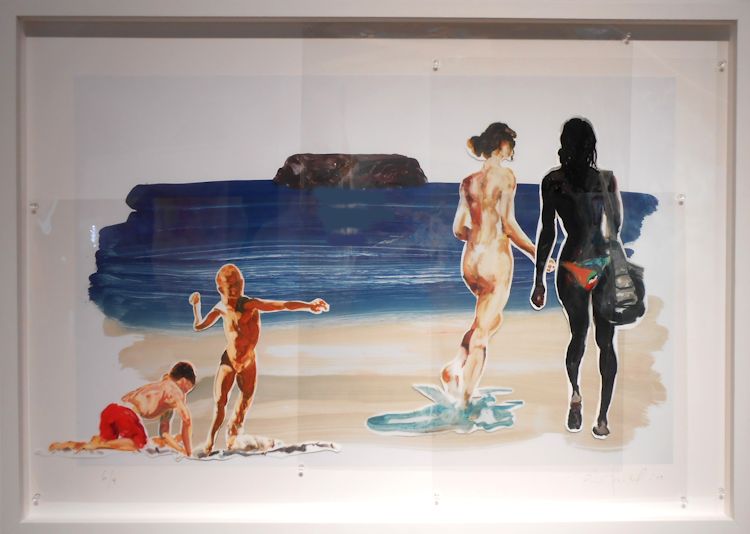


Eric Fischl.  "Beach Scene."  Mylar collage.  U.S.


Tony Fitzpatrick.  "Chicago Monster."  Resin.  U.S.


Tony Fitzpatrick.  "Gramercy Park Bird."  Mixed Media.


Sipho Mabona.  "Folded Gold and White Paper."   Switzerland. 4 ft x 8 ft
His parents are from Africa.  As a child, he enjoyed playing with origami.  He became
perhaps the greatest origami artist in the world, and then began working on a large scale.
These sheets, if folded properly, would make frogs, angels, and whales.


Sipho Mabona.  "Gold and White Origami."  Switzerland.


Sipho Mabone.  "Gold Paper Origami."  Switzerland.
The dealer would not reveal what form this sheet would take in origami.  To find it,
you have to destroy the artwork.


Sipho Mabona.  "Yellow Paper Origami."  Switzderland.


Sipho Mabona.   "Gold Paper Origami."   Switzerland.


__

Thursday, February 8, 2018

Art Basel Part 4


The Helly Nahmad Gallery is always the first on the left as you enter and always has
several very fine artworks for sale.  The Picasso on the wall in the back at the center
was sold for $22 million, according to reports.


Wayne Thiebaud.  "Deli Display."  California.
Thiebaud's characteristic work displays consumer objects such as pies and cakes
 as they are seen in drug store windows. Thiebaud uses heavy pigment and exaggerated
colors to depict his subjects, and the well-defined shadows characteristic of advertisements
 are almost always included. Objects are simplified into basic units but appear varied using
 seemingly minimal means.  Though Thiebaud is most often grouped with the Pop art
movement for his subject matter, the artist considers himself “just an old fashioned painter,”
and “not a card carrying Pop artist.” He remains best known for his still lifes of confections—sometimes painted from his own memories—which he considers interpretations of
“Americanness.” In his works, objects and their shadows are characteristically outlined
in multiple colors, creating a visual effect Thiebaud calls akin to vibration.


Wayne Thiebaud.  "Birthday Cakes."  California.


Kees van Dongen.  "The Clown."  Dutch/ French Fauve.
Van Dongen is known for his brilliant color.


Kees van Dongen.  "Seated Nude."  Dutch / French Fauve.


Rene Magritte.  "The Explanation."  1952  Belgian Surrealism.
Surrealists used the subconscious mind and dreams for their inspiration; some,
 like Magritte, painted in a super-realistic style.


Rene Magritte.  "Domaine of Arnheim."  1962  Belgian Surrealism.


Rene Magritte.  "Visible Thought."  1961  Belgian Surrealism.


Rene Magritte.  "Memory of a Journey."  1959  Belgian Surrealism.


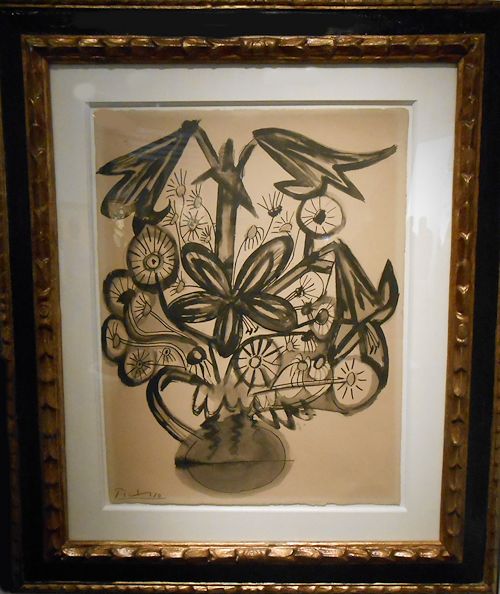
Pablo Picasso.  "Bouquet of Flowers." Spain.  Pen and ink drawing.


Pablo Picasso.  "Man with a Sword."  Spain.
Sold for $22 million.


Sanyu.  "Still Life with Fruit."  Japan.  2017


"Quilt and African Statue."


Markus Lupertz.  "Susanna."  German Neo-Expressionism.  2017    6 x 9 feet.
  The big painterly canvas displays an archaic greeting of heroic figures.  But here we also
 stumble upon zones of total abstraction: a white trapezoidal form at the left edge and a little
 red necktie shape dangling from the top edge.  The men are dark and the woman light-skinned
 – a sure sign that Lüpertz is evoking the gender distinctions of ancient wall painting.
  The horse’s head is missing, as is one of the man’s legs, creating the impression of a centaur.
 A liminal zone of fat pointillist daubs around the horse’s shoulder suggests a magical
 transition between equine and human.  For Lüpertz, the archaic hybrid of the centaur says
 something profound about the nature of painting and the process of abstraction.  In his view,
 the centaur – in its combination of the rational and emotional – is painting.
It sold for $3.4 million; Lupertz is 76 and a leader of German Neo-Expressionism.


Yves Tanguy.  "Beneath the Sea."  French / American.  Surrealism.


Yves Tanguy.  "The Ochre One."  French / American.  Surrealism.


Serge Poliakoff.  "Untitled."  French Abstraction / Tachisme.
Serge Poliakoff (1906-1969) was born the 13th child of 14, in Moscow. His father bred
horses and supplied the czar's cavalry. Raised by a religious mother, Poliakoff attended
 church almost daily as a child, and the strong colors and contemplative, mimetic power
of religious icons would fascinate him for his entire life.  He was a Russian-born French
 modernist painter belonging to the 'New' Ecole de Paris, known as Tachisme.


Maria Elena Vieira da Silva.  "Furnace."  1952.  Portuguese / French.  Abstract.
Her father was a diplomat, and the family moved frequently to many countries.
She was exposed to all of the new styles of art and studied in many schools.


Karel Appel.  "Untitled."  1960.  Cobra / Abstract.
Karel Appel was a Dutch painter, sculptor, and poet.   He was one of the founders
of the avant-garde movement Cobra in 1948, bringing together avant-garde artists
 from Copenhagen, Brussels, and Amsterdam.


Nicolas de Stael.  "Still Life."  Russo - French.  Abstraction.
Nicolas de Staël was a French painter of Russian origin known for his use of a thick impasto
 and his highly abstract landscape painting.  De Staël's family was forced to emigrate to Poland in 1919 because of the Russian Revolution; both his father and stepmother died in Poland and the orphaned Nicolas de Staël was sent with his older sister Marina to Brussels to live with a Russian family (1922).  In 1941, he moved to Nice where he met Jean Arp, Sonia Delaunay and Robert Delaunay, and these artists would inspire his first abstract paintings, or "Compositions."
 Typically his paintings contained block-like slabs of colour, emerging as if struggling against
 one another across the surface of the image.  He committed suicide in 1955 at the age of 41,
 leaving four children and more than 1,000 paintings.


Julio Gonzalez.  "Face and Mirror."  Spanish / French.  Bronze.
 Gonzalez was a friend of Picasso and did most of the sculptural work
for Picasso from his drawings.


Jacques Lipchitz.  "Bather."  1911.  Lithuanian / French.
Lipchitz translated the new style of Cubim, invented by Picasso and Braque,
into the three dimensional forms of sculpture.


Enrico Castellani.  "Untitled Red."  1998  Italy.  Shaped Canvas.
Castellani hammered nails into a board and then stretched canvas across
the surface and painted it a monochrome color.  The light and shadows produced
were spontaneous and changing constantly as the viewer moved.  He liked
the elements of chance and spontaneity and improvisation.


Enrico Castellani.  "Untitled White."  Italy.  Shaped Canvas.


Camille Henrot.  "A Remarkable Ascent."  2016.  French.


Helio Oiticica.  "Orange Space."  Brazil.  Abstract.  (1937-1980)
Hélio Oiticica was a Brazilian visual artist, sculptor, painter, performance artist, and 
theorist, best known for his participation in the Neo-Concrete Movement, for his
 innovative use of color.  He died at 43.


A. R. Penck.   "tskrie."  German  Neo-Expressionism.  6 x 10 feet  


Eric Fischl.  "A Brief History of Africa."  1985     8 x 12 feet   Neo-Expressionism
Fischl often deals with disturbing, rather ominous and ambiguous subjects.
Nudes on a beach are a frequent theme.  His mother suffered from depression and
alcoholism and committed suicide, and he has a feeling of hurt.


Adolphe Gottlieb.  "Burst TR5."  Abstract Expressionism  U.S.
Gottlieb became interested in and influenced by Oriental religions
and philosophy, especially the concept of duality.  The perfect orb of 
serenity contrasts with the conflicting matter below, the
heavenly and the early, the divine and the material.


Kenny Scharf.  "Underaqua."  1986  Graffiti Art.  Spray painted.
These works are done quickly, on a bare wall or fence or subway car, before the police
arrive, and so spray painting is the quicket and easiest method.


Hans Hofmann.  "Green Vase in Blue Room."  German / American.  Abstract.
A Kabinett display was arranged for Hans Hofmann, who had been born and
trained in Germany, but came to the U.S. and became one of the most
influential art teachers in New York, bringing knowledge of all the
latest trends in Europe to the U.S. and training a whole generation of young
American artists who would become the great Abstract Expressionists.


Hans Hofmann.  "Phantasmagora."  1962  German / American.


Hans Hofmann.   "The Blande Interior."  1969.  German / American.


Barbara Chase Riboud.  "Malcolm X, No. XIV."  U.S. Abstraction.   8 feet high
Riboud, an African-American artist living in Paris, has spent 20 years making twenty-seven
monumental works in honor of Malcolm X, most in black, but some in tan or gold.
They usually are part bronze and part fabric.


"Jungle Scene" and "Figures by a Campfire."


"Figures by Camp Fire."


Tony Cragg.  "Antler."  British.  Stainless Steel.  Abstract.


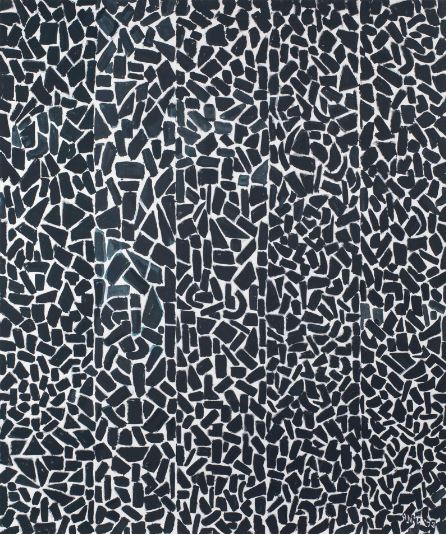
Alma Thomas.  "Late Spring."  U.S.
Alma Thomas was an African-American junior high school teacher in
Washington, D.C. for many years and also a painter.  Her works, usually
of nature and the seasons, look like Byzantine mosaics.  They vibrate and
radiate.


Milton Avery.  "Birds by the Sea."  U.S. Abstraction.
Avery is one of the Fathers of American Abstraction, reducing  subjects to a
very few simple masses.


Ralston Crawford.  "Corpus Christie II."  1976  Precisionism.
Crawford rendered buildings and landscapes with a few precise lines
and forms, as pure as a modern factory or machine.


Ernst Ludwig Kirchner.  "Mountains."  German Expressionism.   1914
Kirchner was a member of the "Blue Rider" group of German Expressionists in
the early 20th century, who were greatly impressed by Van Gogh's use of
expressive, rather than literal, colors.  They believed you should exaggerate color
to convey meanings and feelings.


Wifredo Lam.  "Three Figures."  Cuba.  Surrealism.


Wifredo Lam.   "Figures."  Cuba.  Surrealism.


Georg Herold.  "Beverly."  Cast Aluminum.  2017.  German Expressionism.
Georg Herold lives and works in Cologne, Germany.  His arching and stretching
anthropomorphic sculptures suggest an ambiguous, self-aware state of tension.
The crude stick figure minimalism of the reclining body contrasts with the
visceral nature of the poses. There is something fetishistic about these figures.


Daniel Knorr.  "Miami - Navel of the World."  Romanian.
For this week, Miami was truly the navel and center of the  art world.


Good-bye to Art / Basel / Miami  2017.  Thank You.

__