
This was the 16th year for Art / Basel /Miami Beach, held at the Convention Center in
Miami Beach. About 300 of the world's major galleries exhibit here, and it is difficult
to be admitted. All the artists must be well established, famous, and at the height of their
careers. The fair for beginners and mid-career artists is across the street at Aqua.
The piece above is "Mobile" by Roy Lichtenstein, a Pop Art version of one of
Alexander Calder's famous mobiles, which were all over the fair.


Ugo Rodinone. "Miami Mountain." Swiss. In front of Bass Museum of Art in Miami.
Piles of stones have been important in human history ever since the beginning; cairns were
erected all over North and South America, in Ireland, England, Scotland, Scandinavia; Native Americans erected stone piles; the hoodoos of the Badlands in the U.S. look like this.

A new artist for me was Jonas Wood, a Los Angeles artist, although he seems
to be well-known in the professional world. I saw many of his works in a number
of different galleries. They are all large, 7 or 8 feet high, and almost all have
simplified, flat colored flowers and leaves. The influence of Matisse is strong.

Ugo Rondinone. "Landscape." Ugo is a Swiss-born mixed media artist
working in New York.
working in New York.
What appears to be a white tree is actually a cast aluminum painted sculpture entitled
"hunger moon." The sculpture on the left is "red white mountain" and the piece on the
right is "green black mountain." There are two more "mountains" to the side.

Ugo Rondinone. "green black mountain." Painted stones.

Alice Neel. "Childbirth." New York
Alice Neel had a difficult life, usually with no money, two sons, a series of lovers
and husbands. She couldn't afford models, so she asked friends to pose for her.
One portrait is of a friend dying of t.b.; here a woman is giving birth.
Alice Neel had a difficult life, usually with no money, two sons, a series of lovers
and husbands. She couldn't afford models, so she asked friends to pose for her.
One portrait is of a friend dying of t.b.; here a woman is giving birth.

Alice Neel. "Jennifer." U.S. Realism

Alex Katz. "Pink and White Impatiens." U.S.
Katz made use of large, flat areas of color in his works.

Alex Katz. "Four Figures of Ada." U.S.

Jeff Koons. "Blue Gazing Ball - Velasquez." U.S. Pop Art
Koons is the Grand Jester of Contemporary Pop Art. Here he repaints a famous work
by the Spanish master, Diego Velasquez, and attaches a mirror polished stainless-steel
ball. We gaze into the ball and see ourselves, the world behind us, the painting in front of us.
What is real and what is illusion?

Jeff Koons. "Blue Gazing Ball Aphrodite." Mirror Ball and Marble Statue.
He recarves a famous classical statue and attaches the blue mirror polished ball.

Gunther Forg was one of the leading masters of Abstract Expressionism.
The American style was copied with variations all over the world. Germans were used
to highly romantic and realistic looking paintings. This was a total departure for them.

Gunther Forg. "Untitled" German 6x12 feet

Jaume Plensa. "Duna's Dream." Bronze, Spanish.
Plensa is one of the foremost Spanish artists in the world, with large public
Plensa is one of the foremost Spanish artists in the world, with large public
commissions in major cities. The "Crown Fountain" in Chicago, which has become
enormously popular and successful, is one of his works.

Jaume Plensa. "Duna's Dream." Bronze, Spanish.

Bridget Riley. "Composition with Vertical Columns." Op Art, British. 6 x 12 feet
Riley is the 86 year old leader of British Op Art, playing with color and forms which
change and move with the movements of your eyes.

Hans Arp. "Bending Figure." Marble, Alsatian.

Sol Lewitt. "Not a Single Straight Line." U.S.
Lewitt is a Conceptual and Geometric Abstraction artist, who creates huge murals based
on optical illusions and infinite space. Here, as a joke, he does the reverse; the space is so
shallow it is claustrophobic, and instead of his usual pure straight lines, every line here
is a squiggle and in motion.

Sol Lewitt. " 4x4x4. " Wood, U.S.
This is typical of Lewitt's work which is conceptual and based on geometric progressions.
There are an infinite number of variations to this theme, 3x6x3, 5x8x12, etc.

Jesus Rafael Soto. "Untitled." Venezuela
Soto is one of the great masters of Venezuelan Optical Art. Black sticks and blue sticks
hang from a rod in front of a disk with painted black lines. Air currents move the sticks
slightly, and they seem to vibrate in front of the background.

Donald Judd. "Untitled." Aluminum and Plexiglass. Minimalism.
What makes art?

Robert Mangold. "Open Frame." U.S.
Mangold uses simple geometric shapes of different sizes and lines which seem
slightly askew to create visual tension.

Thomas Houseago. "Large Skull / Devil Dancing." Bronze.
Houseago is a Los Angeles sculptor utilizing the original sculptural subject matter,
the human, body, but with contemporary materals and tools.
Houseago is a Los Angeles sculptor utilizing the original sculptural subject matter,
the human, body, but with contemporary materals and tools.

Peter Doig. "Crow." Scottish.
Peter Doig is a Scottish painter. One of the most renowned living figurative painters,
he has settled in Trinidad since 2002.
Peter Doig is a Scottish painter. One of the most renowned living figurative painters,
he has settled in Trinidad since 2002.

Aaron Curry. "Standing Figure." Plywood.
Aaron Curry is a contemporary American artist known for vividly-colored sculptures.
Both Pablo Picasso and Joan Miró feature heavily in his influences, inspiring Curry's use
of biomorphic shapes and fusion of Surrealism with Pop Art.

Leonor Fini. "Portrait of Stanislao." Italy, Surrealism.
Fini was one of the great surrealists, plumbing her subconscious rather than conscious
mind. She was interested in dreams. Stanislao was one of her lovers.
She was born in Argentina, but brought to Italy as a child and lived there
the remainder of her life.

Leonor Fini. "Portraits of Music and Literature." Italy, Surrealism.
These two works were made for the front doors of a book store in Milan. They look
like Renaissance figures, except that they are female, not male warriors.

Louise Nevelson. "Wall Piece." Wood, Assemblage, U.S.
Nevelson took found pieces of wood from the streets of New York, worked on them
and combined them into her assemblages of memories of furniture she had used,
frames she had seen, perhaps an altar in a Greek Orthodox church.

Louise Nevelson. "Collage." Wood, cardboard, paper, fabric.
She unifies the various materials and forms by use of a single color,
here gold.

Louise Nevelson. "Four Necklaces." Iron, gold, cord. Russian/American.
Nevelson often dressed rather extravagantly in flowing gypsy-like skirts and large-
sleeved blouses. These very large pendant necklaces worked perfectly with her outfits.

Claudio Bravo. "Four Piles of Rocks." Chile, Super-Realism Painting.
Bravo was the great master of super-realism, creating works which looked more
real than a photograph or the objects themselves. This work is about 5 x 7 feet.

Damien Hirst. "Butterfly Print." British
Hirst began by buying large numbers of colorful butterflies and glueing them in
patterns on a sheet, painting with glitter between the wings, then coating all with a
polyurethane coating. Later he made prints of these works, and this is a print -
no actual butterflies involved. The patterns looks like a stained glass window
from a distance.

Robert Motherwell. "Torino." U.S.
Motherwell created collages of many kinds; here he uses various
objects associated with the city of Torino / Turin Italy = the wrapping of a
package he received from Torino, some shreds of musical scores by
Italian musicians from Torino, the colors of the Italian flag, etc.

Robert Motherwell. "XYLOL." U.S.
This is part of the brand label and a box from France.

Elizabeth Murray. "If Only Cup." U.S.
Murray was one of the first artists who shaped her canvases to her images, instead of
fitting her image into a rectangular piece of canvas. This complex frame and
strtetched canvas were created by Murray just for this work, which appears to be
her coffee cup tipping over and spilling. It is about 5 x 5 feet.

Charles Burchfield. "Sunshine and Rain." Buffalo, NY. Watercolor.
Burchfield is a very famous artist from Buffalo, who painted scenes of
the city of Buffalo and gardens in the area. The scenes combine nature
with a mystical feeling and flowering radiating light.

Burgoyne Diller. "First Theme." U.S. Geometric Abstraction.
Diller explored the many variations possible in "First," "Second," and "Third
Themes" of simple rectangles.
Diller explored the many variations possible in "First," "Second," and "Third
Themes" of simple rectangles.
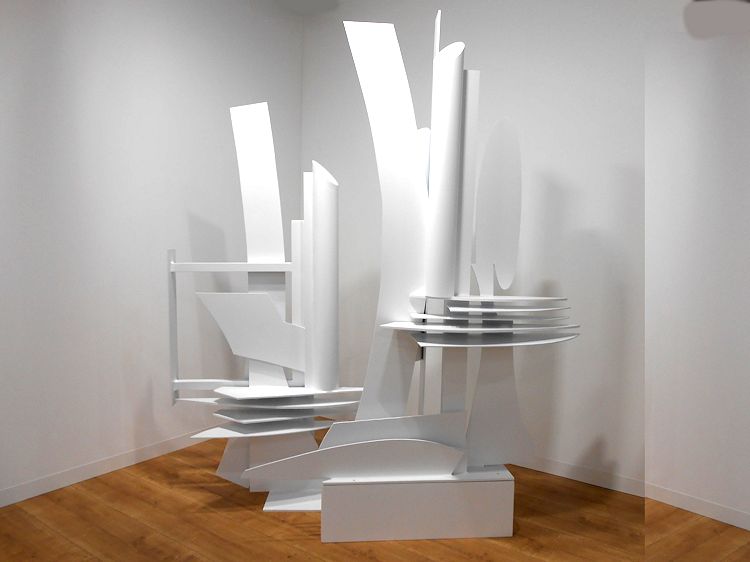
Louise Nevelson. "Double Image." 1976 wood. Russian/American.

Joel Shapiro. "Falling Figure." Wood. U.S.

Jean Dubuffet. "Persons / Trees." Plaster. French.

Alexander Calder. "Red Mobile." U.S. Steel.
Calder was the first artist to make sculpture which moved - kinetic art.
Calder was the first artist to make sculpture which moved - kinetic art.

Alexander Calder. "Mobile" and Print. U.S.

Alexander Calder. "Sun and Mountains" Stabile. U.S. Steel.
This is a maquette or model; the full-sized version stands in front of a major bank.

__


