Sunday, December 16, 2018

Art Miami 2018 - 2


Gil Bruvel.  "Visage."  Wooden Sticks.  France.
The face is made entirely of wooden sticks 10 inches long.


Gil Bruvel.  "Visage."  France.


Fernand Leger.  "Four Men."  French.


Georges Mathieu.  "Arabesques."  French.
Mathieu painted many of his canvases while on a stage before an audience and
using long brushes which he swept around like swords.


David Hockney.  "Punch and Judy."  British.


Damien Hirst.  "Spin Butterfly."  British
Hirst prepares a spinning table and then drips paint on it as it spins.
The above is one result.


Yayoi Kusama.  "Green Pumpkin."  Japan.
The artist is a Japanese lady approaching 90 years of age.  She paints a multitude of
dots in many configurations.  She is very popular, and this small drawing sold for
$58,000.


Andy Warhol.  "Sitting Bull."  American Pop Art.
The print is from the series "Cowboys and Indians."


Enrico Castellani.  "Red Surface."  Italian.
The artist prepares a board with a number of nails at various
heights and in different patterns.  He then pulls a piece of canvas
over the top of the nails and creates light and shadow patterns.


Toots Zynsky.  "Red Crown Amazon."  From "Endangered Species Series."  Glass.
Toots is one of the most famous American glass artists.  She uses a technique of fusing
glass rods of various colors at high temperatures so they fuse.


Toots Zynsky.  "Blue Flycatcher."  From "Endangered Species Series."  Fused Glass.


Victor Vasarely.  Op Art.  Hungarian/French.


Alberto Cavalieri.  "Divine Fire."  Stainless Steel.  Italian.


Eric Fischl.  "Tumbling Woman."  Glass - Lie-sized."


Carlos Rolon.  "Decadence of Decadence."  Cuban.
The highly realistic flowers are painted on a sheet of aluminum.


Shepard Fairey.  "Welcome Visitor."  American Graffiti Artist.
Shepard is one of the most famous Graffiti artists in the world, with huge murals in
many countries.  he also does small paintings and prints, which frequently have a
social or political message.  This is a print.


Fernando Botero.  "Last Day of Carnival."  Colombia.


Paul Rousso.  "Magazine Covers with Jackie Robinson."  U.S.
Rousso prints papers or magazines on sheets of acrylic.  He then heats the acrylic
to that he can bend and shape it.  This is a large work, eight feet long, made of
several dozen sheets of shaped acrylic.


Tom Wesselmann.  "Nude in Bedroom."  U.S. Pop Art.
This is a steel cut-out, made by laser, and is a new type of drawing, not pencil nor
brush, but steel.


John Chamberlain.  "Schadenfreude."  U.S.
Chamberlain chose to make sculpture not of wood or marble or bronze, but of
the steel, which he could find and buy cheaply in auto graveyards.  This is a bunch
of fenders, painted and bent into shape.


Adolph Gottlieb.  "Asterisk on Brown."  U.S.


Robert Indiana.  "LOVE."  Aluminum.


Joana Vasconcelos.  "Karenina."  Cuban.
The artist makes animals of fiberglass, in this case a lizard, and then
crochets a "skin" which can be pulled over the figure like a stocking.


Kikuo Saito.  "La Tras."  Japanese/American.
Kikuo's works sing with a lyrical quality.


John Chamberlain.  "Suede Dog Peas."  U.S.
The sculpture stands four feet high and is made of bent
and painted auto fenders.


Mel Bochner.  "Blah - Blah - Blah."  U.S.
Handmade embossed paper, which is then painted.


Mira Lehr.  "Reflections."


Alexander Calder.  "Eight Balls."  U.S.


Olga de Amaral.  "Tunic."  Colombia.
Olga is an 86 year old lady, who just retired, and used textiles
is new ways.  She hired the women of her village to help make
these elegant hanging pieces.  They are made of linen, painted,
cut into small pieces, and sewn or glued to a linen background.
They look like a garment for an Inca emperor.


Olga de Amaral.  Close-up.  She closed her studio this year and will be making
no more textile art works.


Paul Jenkins.  "Phenomeon - Rays."  U.S.
The paint is poured on the canvas and then moved around with
sticks and spatulas.


Donald Sultan.  "One Red Flower."  U.S.  Aluminum.  36 in high.


Pablo Atchugarry.  "Column."  Carrara Marble.
Pablo's sculptures look like they are soft and pliable, whereas in reality they are
of hard stone and marble.


Alexander Calder.  "Mobile."


Roy Lichtenstein.  "Portrait in Brushstrokes."  Aluminum.  U.S. Pop.
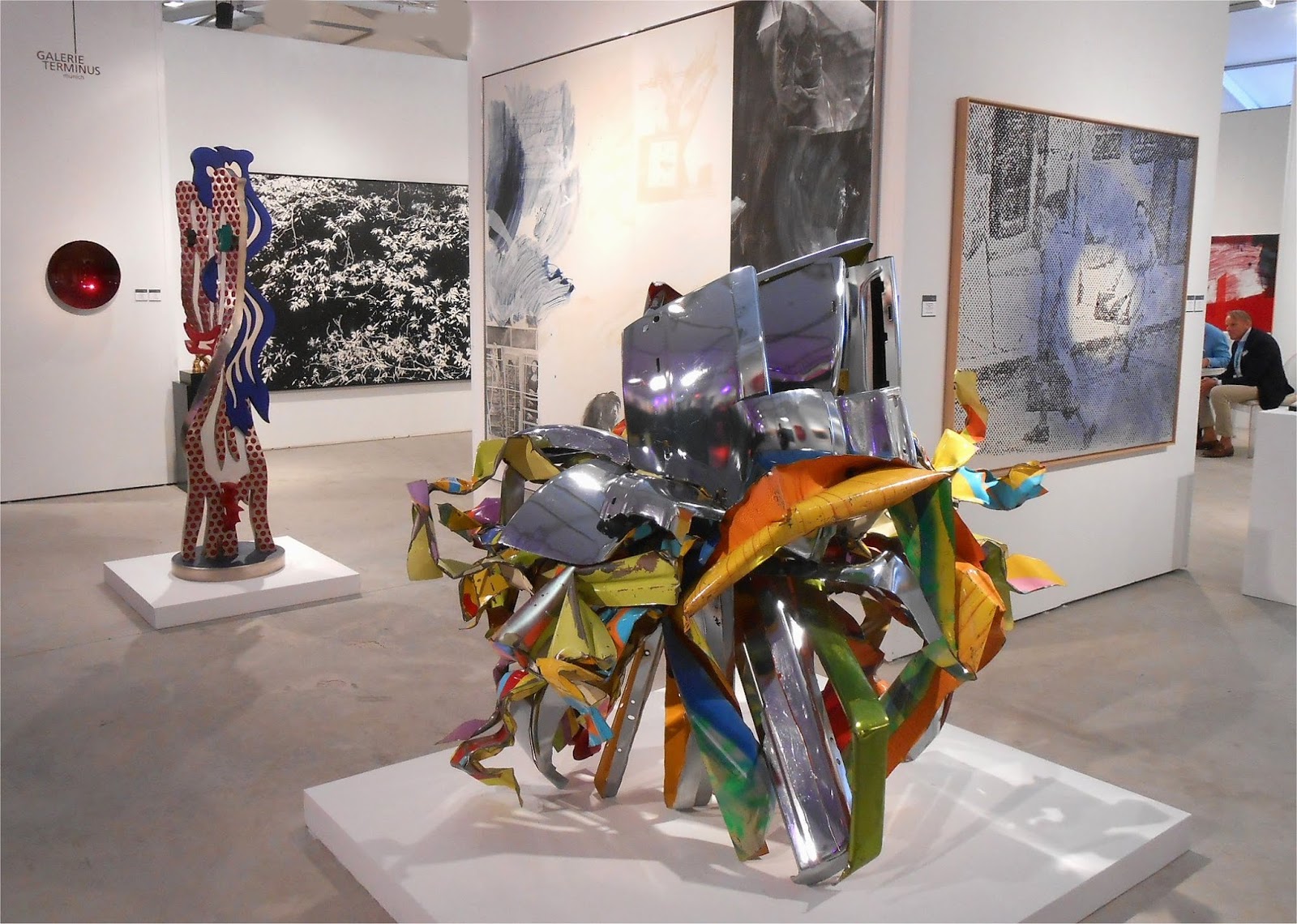


Sculptures by Roy Lichtenstein and John Chamberlain.


Manolo Valdes.  "Infanta Mariana."  Spanish.
The three figures are carved of wood and coated with eopxy.   The two portraits are
collages; and the black aluminum head has hair which fans out.


Jesus Rafael Soto.  Victor Vasarely.  Three Op Art pieces.


Sri Lankan Artist.  "Butterflies."


Paul Rousso.  "Magazine Covers."  Shaped acrylic sheets.


Ibram Lassaw.  Bronze Sculpture.


Qin Feng.  "Desire, Landscape."  Chinese.
The opportunity to view art by Chinese and Japanese artists is a special treat
of the fair.  They often combine ancient themes and techniques with
modern subject matter.


__


Tuesday, December 11, 2018

Art Miami 2018


"Art Week in Miami" just ran from Dec. 4-9, with more than 24 shows and 1,000 galleries
from all over the world bringing their choicest works to Miami.  There is nothing else like it
in the world.  I first went to Art Miami, which is located in Miami along side Biscayne Bay and
showcases 267 of the world's finest art galleries and most famous artists.  It was the best
it has ever been, and marvelous.   The art is modern and contemporary, from 1900 to the
present, and most of it since 1950.  We were greeted in the parking lot with a number of
sculptures, including "Gummy Bear" by German artist, Whisbe.  He comments on
consumerism in society and brand names.


This is one of the oldest works in the show, "Clown" by the Belgian artist
Kees van Dongen, from 1917.  He was a Fauve - he liked brilliant, arbitrary
color and simplified forms.


Robert Indiana took the form of the iron grate on drains and combined it with
sign boards and traffic signs and changed a few words.  This is a tribute to
Pablo Picasso Ruiz, who was born in 1881 and died in 1973.


Alexander Calder was an American artist with a playful nature, who came to spend half of
each year in France and half in the U.S.  He invented the mobile from pieces of things and
wire he found on the street or sidewalk by the outdoor cafes where he liked to sit.  They balance
 and they move, something utterly new for sculpture.  The piece above is about 16 inches high;
 a few years ago, it sold for $16,000.  This week the price was $488,000.


Fernando Botero is an artist from Colombia, who now works in New York and Paris.
His figures look inflated and doll like.  This is "Flamenco Dance."


Paul Jenkins is an American artist, who decided he was not interested in painting
realistic-looking objects, any camera or cell phone can do that.  But he was interested in
color and form and movement.    So he began to pour pigments on canvas, and then spread
them around with spatulas and sticks, to create "Phenomenon: Green."


Kenny Scharf is a New York graffiti artist.  He began by spray painting images on
walls and subways.  He had to work quickly, with cans of spray paint, to avoid arrest.
He continues many of the techniques and subjects of Street artists/graffiti artists in his
paintings on canvas these days.  He has a huge wall mural in Wynwood, a mile to the NW.


The interior of Art Miami, showing how one gallery has divided its space and shows its
works.  The tall object is "Totem" by the Graffiti Artist, Keith Haring.


One of the special qualities of the show is the high number of Latin American and Asian
galleries, which now participate.  There were more galleries from Asia than ever before.
This is in the Fukuna Gallery, which featured works in a variety of media.  This is a
ceramic piece by a Japanese artist.  I have not memorized their names yet.


In the background are two paintings by Russian-French artist, Marc Chagall.
On the two pedestals are works by a Japanese woman artist.  They began as flat sheets
of copper, which she folds and bends by hand.  She then covers the surface with enamels
(ground up glass) and fires them to the surface, so they are glass and jewel like.


RETNA began as a street artist and he has huge walls covered with his scripts all over the world.
Fortunately we have a number in South Florida.  The symbols are a purely artist language,
made up of elements from Roman script, Arabic script, Russian, and purely invented.
Some of his murals are six stories high.  These are scripts on canvases, so that people may
purchase them and enjoy them in their homes.  He does not get paid for his murals.


Jeff Koons, "Balloon Dog Plate - Orange" in porcelain.  $11,000 each.
Koons was the highest priced contemporary artist in the world, with a balloon dog full size 
selling for $57,000,000 until a month ago.


Marc Chagall.  "Sun and Red Horse."  Russian / French Fantasy.
Chagall fled from his home in Russia to Paris, but he never forgot the folk myths
and stories of his youth.


Tom Wesselmann.  "Monica Reclining on Bed."  Laser cut steel.
Wesselmann invented a new way of drawing, with steel as his line.  The image is cut 
from a sheet of steel by a laser and then painted.  So what we see is a "drawing" in steel made 
by Wesselmann, a Crayola drawing on a large scale and in steel.  He is a Pop artist.


Manolo Valdes.  "Head with Gold Butterflies."  Spanish.  Bronze.
Valdes is probably the most famous and prolific living Spanish artist.  He works in New York
and Spain, with a huge workshop that helps carry out his many commissions.
This subject of a head and "hair" of leaves or butterflies or other objects has been used
many times in many colors and materials.


Kenneth Noland.  "Blue, Black, Yellow."   Hard Edge Abstraction.  U.S.
Noland and his friends didn't believe artists should tell stories or try to imitate space in
their works, they should simply apply color to canvas in some simple form that a
viewer could immediately see and understand; you didn't need someone to explain
the meaning behind the objects.


Noland also painted chevrons, in many colors and very large sizes, but all utterly simple
and able to be understood in one glance.  No symbolism or hidden meanings.


David Smith.  "Zig I."  Painted Steel.  U.S. 
Smith created Abstract Expressionism in metal.  Instead of carving wood or marble,
or casting bronze or gold to make statues, he assembled 3D images from steel scraps
he picked up off the floor of the foundry where he worked.


Ms Niki de Saint-Phalle.  "Nana with Serpent."  French.  Marble.
Niki created large, playful female figures, not rigid, frozen figures.


There were many works by Andy Warhol available at the show.  These are three of his
prints: one for life savers and one for Apple, two famous brand names.  And then the most
famous hero figure in the world, Superman.  Warhol took the images of popular, everyday
culture and turned them into art.


Alberto Sosabravo.  "Couple at Carnival."  Cuban.


Irina Gonzalez.  "Woman with Cat."  Cuban.
Gonzalez creates formal, Renaissance-like portraits of women
dressed in elaborate, detailed costumes.


Irina Gonzalez.  "Woman with Pincushion and Ballooon Dog."  Cuban.
The elaborate dress and hair contrast with the everyday pincushion
and balloon dog, which might have been made by artist Jeff Koons.


Amelia Pelaez.  "Fish on Plate."  Cuban Cubist.
Amelia is one of the greatest of Cuban artists, who created works which often look
like stained glass windows, with their rich colors and strong black outlines.
All of these works were provided by the great Cernuda Gallery of Miami.


Op Art and Geometric works are very popular in Latin America.  On the left back wall
are two works by the Colombian artist Omar Rayo and the aluminum sculpture is by
American Brad Howe.


The three mysterious red and black paintings are by the greatest of Peruvian artists,
Fernando de Szyslo, and the gold sculpture is by the Uruguayan sculptor,
Pablo Atchugarry, who usually works in white marble.


"Dean Project" is a gallery specializing in contemporary art.  Hunt Slonem created the
"Bunny Head" sculpture, and the painting on the left wall is of rabbits.  He also created the
central wall with 100 yellow parrots.  On the right back wall is a word work by Mel Bochner,
where letters make up not only images but words.  And the portrait on the right is by
Hendrik Kerstens of his daughter in the Netherlands.


Hunt Slonem.  "Pink Rabbits," "White Bunny Head," and "Wall of Yellow Parrots."
Mr. Slonem keeps rabbits and parrots in his house.


Andy Warhol was most interested in making money, so he thought the most appropriate
subject he could paint would be the dollar sign; and today the piece of canvas is worth
$35,000.  The ubiquitous Campbell Soup Can once sold for $250, but this week it is on sale
for $48,000.  Pop Art took the images of popular culture, isolated and enlarged and
simplified them and said they were as much art as an image of Venus or Napoleon.


Francois-Xavier Lalanne created "Sheep" of various materials.
It is usual to buy several for a group in your home.  Some are of bronze, others wood,
some of combined materials.


This is the booth of Frederick Got, who has galleries in Paris and Montreal and elsewhere.
These works are all by his popular artists, and all come in various sizes.  The two abstract
but connected heads are by Jacques Lebescond, the horse and goat are by Roberto Mata;
the butterflies on gold background are by Hunt Slonem.


Frederick Got Gallery.


Philippe Huipily.  "Marathon Runner."  French.  Steel.


Paintings by Jonone and two figures, in fiberglass and hoodies, are by Mark Jenkins.


An artist from Sri Lanka (Ceylon) created "Hummingbirds."   4x6 feet


Sonia Delaunay.  "Black Serpent."  French.  Tapestry.
Sonia and her husband Robert were some of the earliest abstract artists.  Sonia also insisted
on using textiles as a valid "fine art."  The above is the largest tapestry she made.


Sonia Delaunay.  ""Orphism."  French.  Tapestry.


Luis Cruz Azaceta.  "Yellow Red."  Cuban American.


Jonone. "Homage to the Number Three."  Graffiti Art.
"Jonone" is the art-name for a street artist from Miami who often uses
calligraphic like lines in a dense script.  He is well known for his
large outdoor murals.


Speedy Graphito.  "Big Love."  Graffiti Art.
Speedy is one of the founders of Street Art in Paris, and he is in
high demand for commercial art and advertising campaigns.  He uses
readily recognized images from films and advertising to create new works.


__